
backstory
Dam Across the Bering Strait
Talks of connecting the continents had existed for more than a century, yet there had never been enough material resources nor political will to make it possible. In 2000, after the collapse of the USSR, democratic elections, and a series of reforms in Russia that established a strong pro-Western government, the idea once again began circulating among the highest levels of power.
The plan envisioned a dam that would connect two continents both territorially and economically, transforming the harsh climate of the Russian Far East and American Alaska into a temperate environment suitable for habitation, agriculture, and the development of new cities in anticipation of growing populations and migration from increasingly hotter regions. The dam was meant to become a monument to a new age of cooperation and to mankind’s dominion over nature itself.
Yet the construction of such a colossal structure carried enormous risks. Climatic risks above all. The dam was intended to stabilize thermohaline circulation and stimulate ice formation in the Arctic, buying humanity more time in its struggle against global warming. The problem was that if this struggle ultimately failed, the unavoidable consequences of warming would only grow more extreme — even if they became less frequent. It was an extraordinarily dangerous gamble.
Moreover, a project of this scale would require no less than two decades of construction, colossal material resources, and a stable geopolitical environment. On the other hand, the world was becoming more interconnected: the unified “Northern Bloc” could now secure the project, provide it with resources, and the sheer duration of the construction itself, in a sense, reinforced the belief that global cooperation was unbreakable.
Finally, in 2004, the beginning of the great construction project was officially announced.
The dam was given the name Titan — in honor of humanity’s titanic effort on the path toward a new world. Though it is also believed that the name alluded to ancient Greek mythology, where Oceanus, eldest of the Titans, ruled over the great world current, a fitting parallel to the dam’s intended purpose.
The finest engineers from Russia and the United States, from Europe and Asia, united around the project. Tens of thousands of people were involved, directly and indirectly. Rotational worker settlements sprang up on both sides, thousands of kilometers of power lines were laid down, logistical networks established. Near the town of Mirodolsk, which primarily supported construction from the Russian side, two massive concrete plants were built alongside cargo ports and a railway network capable of producing millions of cubic meters of concrete. Dozens of quarries across the region entered development. Power stations were built, floating nuclear plants deployed. Gradually, the construction site was becoming a world of its own, while the world itself was turning into one endless construction site…
The foundation of the dam stretched for 88 kilometers, linking the North American continent at Wales with Eurasia at the Russian town of Mirodolsk. Major highway and railway routes were planned to run across the structure, alongside its own wind and hydroelectric power systems, as well as locks with water elevators to maintain maritime passage between the Arctic and Pacific Oceans. On the Russian side of the dam, a new district of Mirodolsk was being built with residential buildings, cafés, shops, schools, and government services — a place where engineers and scientists would live once the dam entered operation. And at the very center of Titan, plans called for the construction of the massive Diomid research complex, where scientists would study ocean currents, biology, energy systems, and climate.
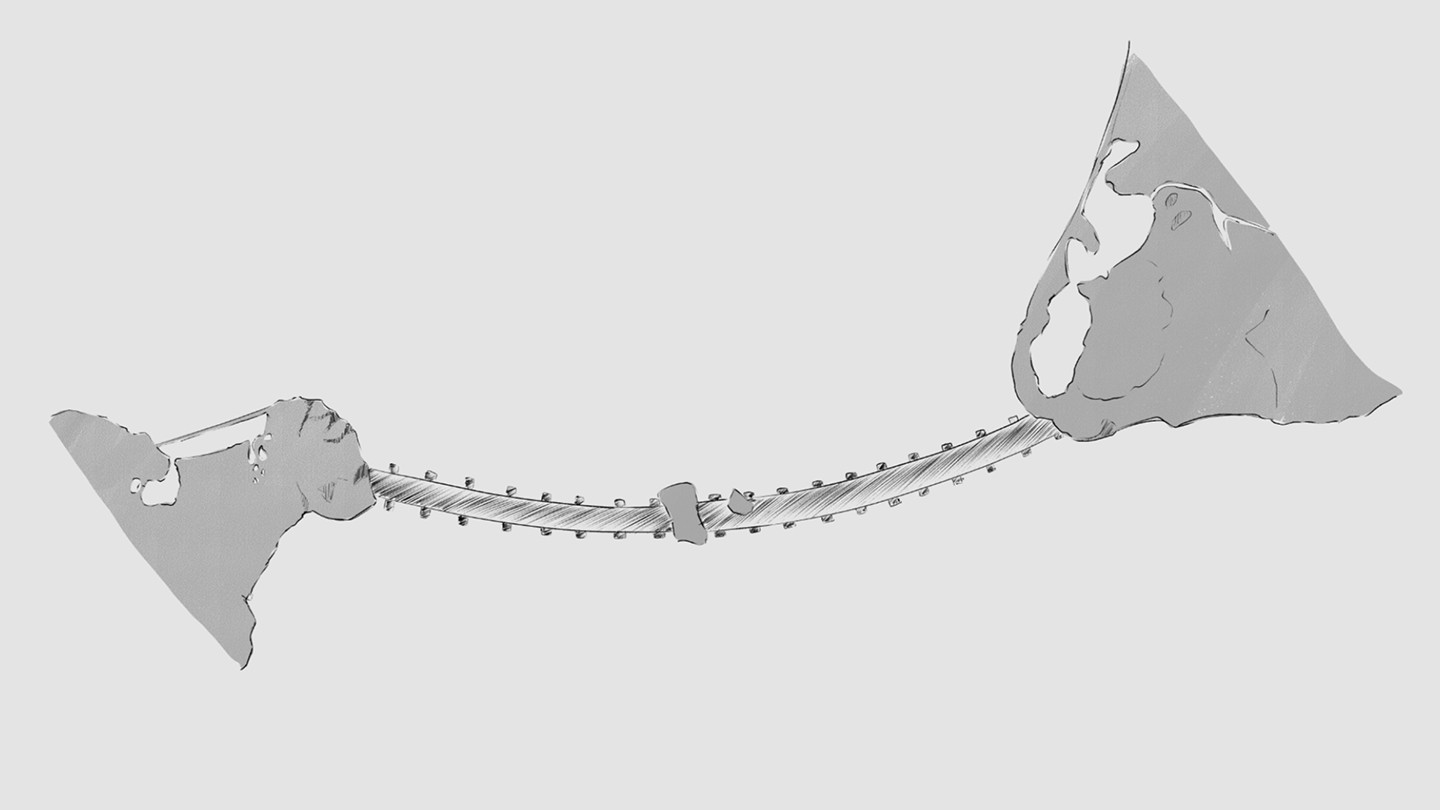
Naturally, a megastructure of such importance — one capable of influencing the global climate and determining the stability of the entire Northern Hemisphere — required protection from eco-terrorists, saboteurs, and every other kind of hostile actor.
Responsibility for security was delegated to the newly formed American company Titan Security, alongside a contingent of KZR personnel. However, after nearly twenty years, as terrorist threats from radical Islamist groups reached a critical level, concerns emerged over whether Titan Security was truly capable of defending the dam against real threats. As a result, in 2021 the company was absorbed by the far more experienced and heavily equipped PMC Patriot Defence Services — now known as Echelon.
***
As relations within the Northern Alliance began to cool, as Igor Sablin came to power in Russia and the country shifted its political course, construction of Titan came to a halt. Just short of completion. Despite this, scientists continued working within the Diomid complex. Research into altered ocean currents and climate patterns had already been underway for several years. The friendship between the newly divided West and East was no longer spoken of, yet even so, the scientific community continued trying to work toward something greater than either side — something important for all humanity.
On March 13, 2027, an explosion rocked the Diomid complex. Part of the upper floor collapsed. Troopers of PMC Echelon received an urgent order to evacuate scientific personnel and recover critically important research data. Amid the chaos, a firefight erupted between Russian guards and Echelon operatives emerging through smoke and dust.


Finding neither the scientists nor the data, but meeting armed resistance, the Americans concluded that the explosion had been a Russian act of sabotage, and that the information was now being transferred to mainland Russia.
The American authorities were convinced that the release of this information would окончательно destroy the unity of the “Northern civilization”, within which they had secured a dominant position. Hesitating, President Paul Bennett gave the fateful order.
Intercept them.

